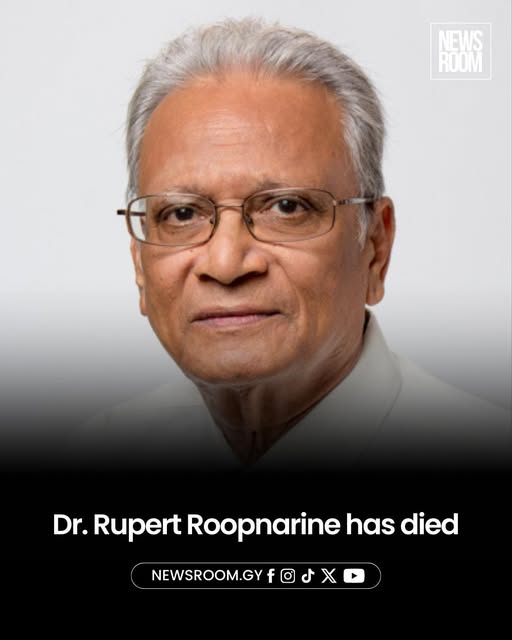
It is with deep sorrow and respect that we bid farewell to Dr. Rupert Roopnaraine, a remarkable scholar, parliamentarian, and government minister, whose contributions to Guyana’s political and intellectual landscape will be remembered for generations to come. Dr. Roopnaraine passed away early Monday morning at the age of 83, leaving behind an enduring legacy that shaped the nation’s post-colonial experience and political discourse.
Dr. Roopnaraine’s life was defined by his unwavering commitment to national unity, multiparty governance, and progressive politics. As a founding member of the Working People’s Alliance (WPA), he was a tireless advocate for a more inclusive and equitable Guyana. His advocacy for multi-ethnic unity in a divided society set him apart as a rare political figure who transcended race and ethnicity. He never shied away from his East Indian identity, but his political philosophy emphasized that Guyana could only move forward if all races and communities worked together in harmony.
Throughout his distinguished career, Dr. Roopnaraine was a vocal advocate for constitutional reform and national unity. His work in proposing a national interim government in 1992 and his involvement in discussions during the 1997 constitutional crisis were testaments to his deep belief in the importance of collaboration and collective governance. His political vision and strategies were foundational in the creation of the A Partnership for National Unity (APNU), and his role as the prime ministerial candidate in the 2011 elections marked a pivotal moment in Guyana’s history, where the ruling party was reduced to a minority government for the first time.
Beyond his political career, Dr. Roopnaraine was a respected scholar and intellectual giant. He was a former lecturer at the University of Guyana and a literary authority on the works of poet Martin Carter. His creative contributions extended to filmmaking as part of the Victor Jara Collective, where he helped produce the influential documentary The Terror and the Time. His academic and creative pursuits, coupled with his activism, made him a true renaissance man whose influence reached far beyond politics.
Dr. Roopnaraine’s personal sacrifices during the turbulent 1970s and 1980s, including numerous arrests and his detention alongside the late historian Walter Rodney, further solidified his legacy as a fearless advocate for justice and freedom.
As we mourn the loss of Dr. Rupert Roopnaraine, we also celebrate his life and the indelible mark he left on Guyanese politics, culture, and intellectual thought. His commitment to unity, intellectual curiosity, and bravery will continue to inspire future generations. The political and academic landscapes of Guyana are poorer without him, but his legacy will endure in the many lives he touched and the causes he championed. Rest in peace, Dr. Roopnaraine.